Situational Leadership Model — Ken Blanchard's SLII Explained
Complete guide to Ken Blanchard's Situational Leadership II (SLII) model. Learn the 4 leadership styles — directing, coaching, supporting, delegating — and how to apply them by development level for the PMP exam.
You're viewing a free preview of the Study Guide. Upgrade to access all 500+ pages.
Ken Blanchard's situational leadership model focuses on adapting leadership styles to meet the needs of individual team members based on their level of competence and commitment.
Competence refers to a team member's level of knowledge, skills, and experience related to a particular task or responsibility. Competence can range from low, where the team member is new to the task and lacks experience, to high, where the team member is very experienced and knowledgeable.
Commitment refers to a team member's level of motivation and engagement related to a particular task or responsibility. Commitment can range from low, where the team member lacks motivation or is disengaged, to high, where the team member is highly motivated and fully engaged.
The model is based on the idea that different situations require different leadership styles, and that effective leaders are able to adjust their style to fit the needs of the situation and the team member.
It maps four leadership styles - directing, coaching, supporting, and delegating - to four competence and commitment levels of the team members as shown in the image below.
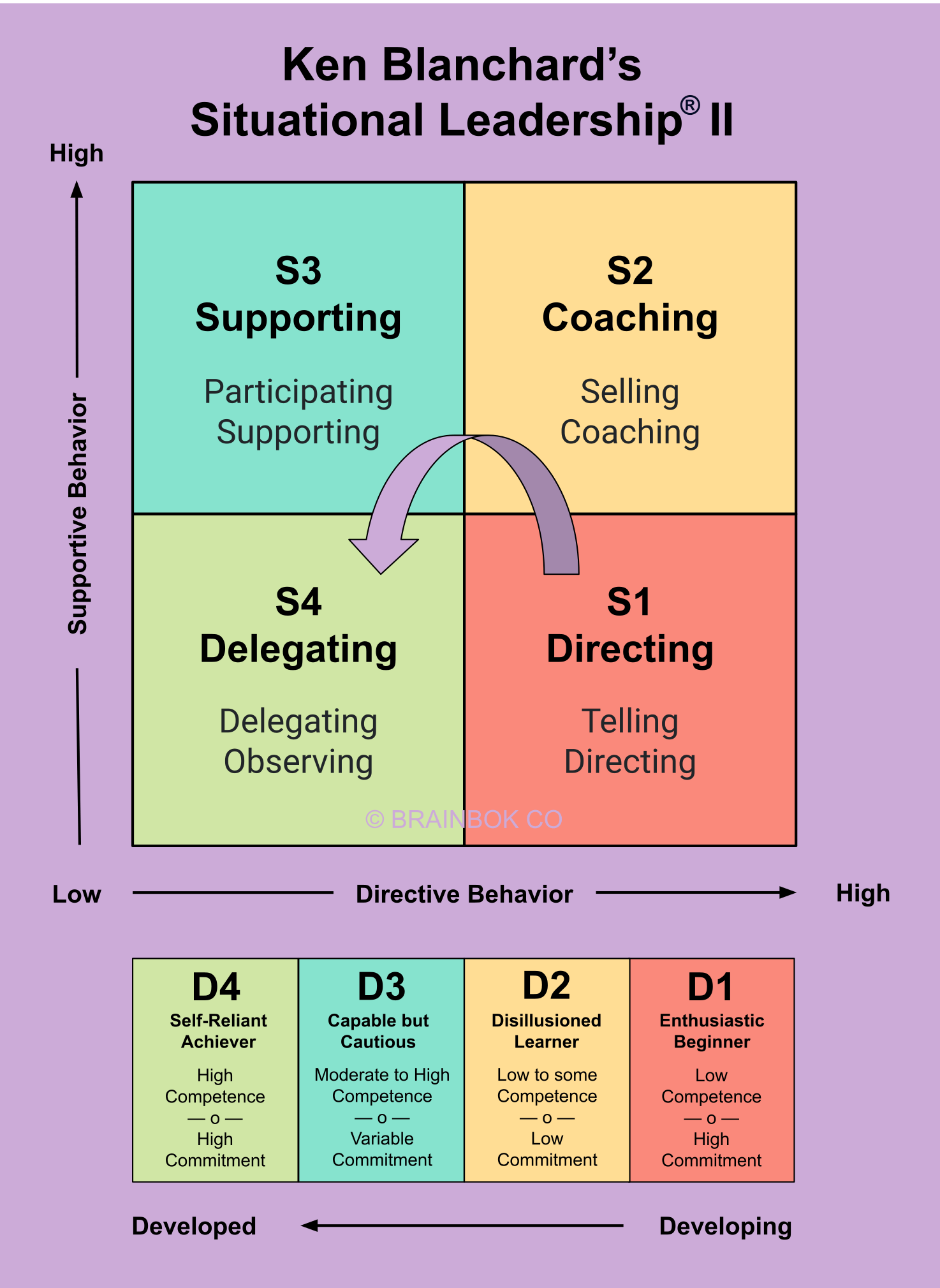
The key takeaway is that effective leadership involves adapting one's style to the competence and commitment levels of team members. Leaders should provide more direction and support to those with lower competence and commitment and gradually reduce directiveness and support while increasing delegation as team members become more competent and self-reliant.
Related Topics
- Dreyfus Model of Skill Acquisition — understand team member competence levels
- OSCAR Coaching and Mentoring Model — a complementary coaching framework
- Leadership Styles — overview of all leadership styles including directing, coaching, supporting, and delegating
References
Enjoying this article?
BrainBOK members get everything they need to pass the PMP or CAPM — all in one place.
- 500+ Study Guide pages across all PMP & CAPM domains
- 2,000+ practice exam questions with full explanations
- ITTO Explorer — visual maps for all processes & knowledge areas
- Adaptive flashcards for fast terminology recall